Odor fatigue or how to decode perfumes
By Maksim
Founder of HPC
25 December 2024
Why your nose goes blind after a few sniffs, what is happening at the receptors when it does, and how to turn that against a perfume you want to take apart.
This is the research post about odor fatigue (also known as olfactory fatigue or nose blindness) and unexpected side effects that can be used to reproduce unknown perfume formulas.
Odor fatigue is simply when you stop smelling something because you're overexposed to a smell, your nose just got tired. For example, it happens when you can't smell your own perfume but others around you very much do or when you go to a perfume store and after 10 minutes in there, your nose becomes "blind".
At our perfume-making workshops, we do blind smelling of raw materials and we naturally get odor fatigue, we need to take a rest, drink water, have fresh air, and smell our own skin to reset our palette. It comes back after a while.
How does it work?
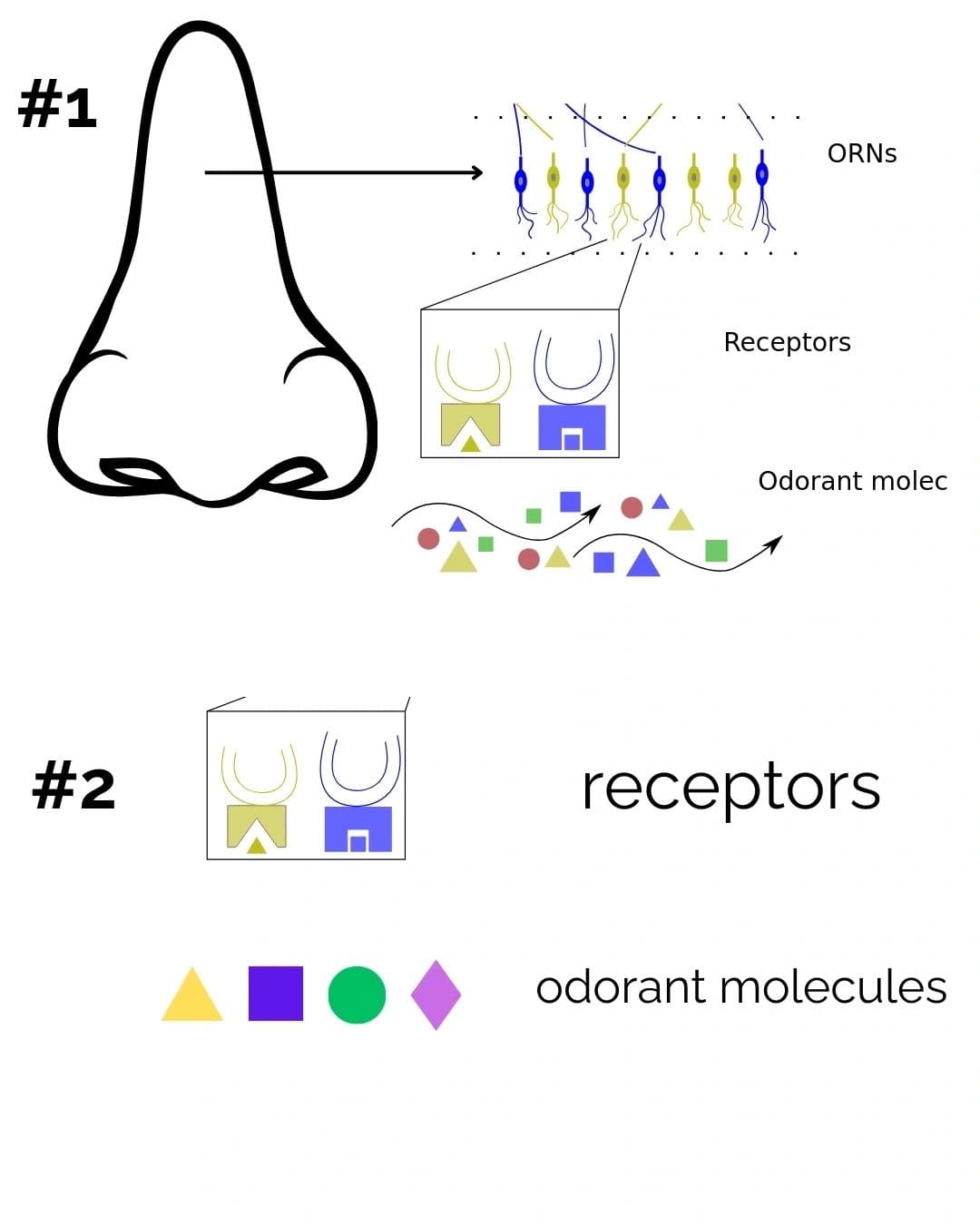
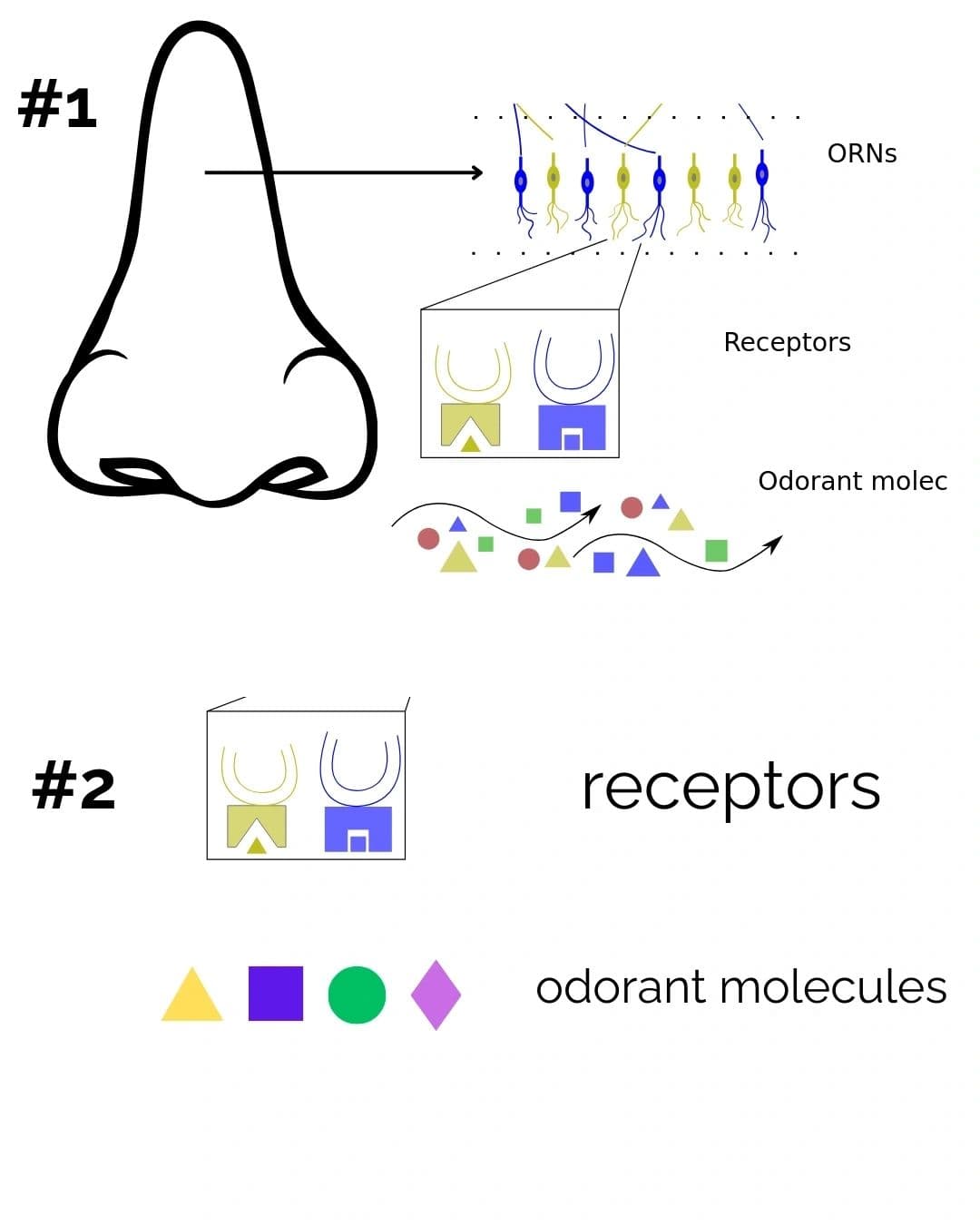
There are odor receptors in our nose (#1 in the pic) that can "read" odorant molecules that travel over the air.
According to the main Lock-and-key odor theory (or shape theory), the shape and size of the molecule define its' smell (there's alternative vibration theory, but we won't go there)
"Locks" are represented by odor receptors, and "keys" are odorant molecules (#2 on the pic and #3 below).
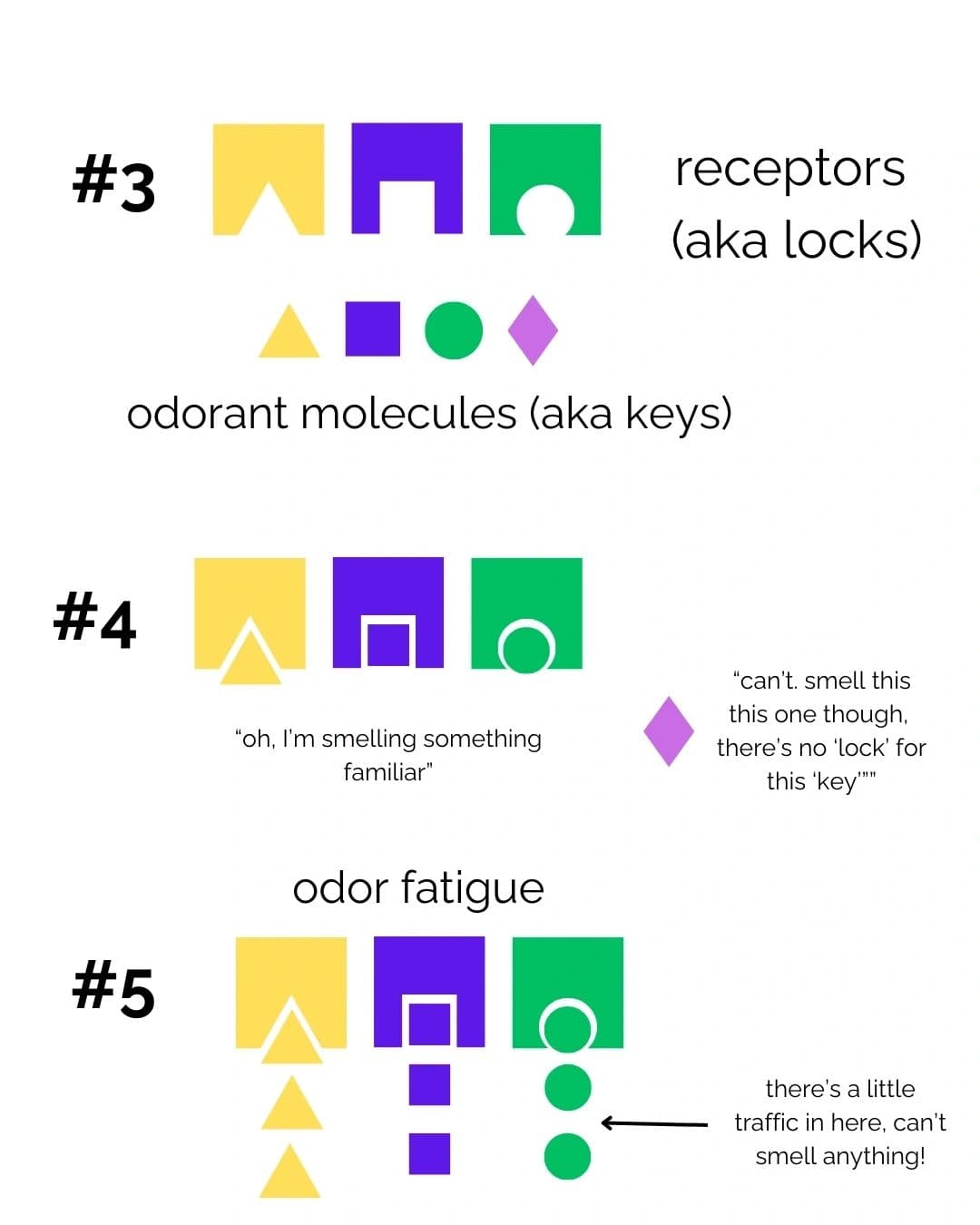
When a molecule reaches the nose it can be bound to one or more receptors, sort of "unlocking" the door. That's called activation. When a receptor is activated, our brain gets a signal "Aha, I'm smelling something familiar right now".
Humans have ~400 functional receptor types that can detect a wide variety of odor molecules (mice have 1400).
For instance, in step #4 on the picture, there is a "purple diamond" on the right that is not recognized by the nose because there's no "lock" for it.
Odor fatigue (#5) is when there's traffic in your nose, and too many molecules layered up, it blinds receptors, brain stops paying attention to it and prioritizes other signals (aka olfactory adaptation). That is what happens after a few deep sniffs of your favorite perfume.
Understanding this mechanism even on a high level has few useful takeaways when working with perfumes and raw materials.
Takeaway #1: Smell for 1-2 seconds and put the scent strip away from your nose.
You smell with your brain, that's where you recognize odors, whether it's pleasant or not, etc. Inhaling deeply and frequently just creates traffic of molecules in your nose and it loses sensitivity.
Takeaway #2: To reset your nose quicker, you need to stop adding extra layers of molecules.
Coffee beans don't work, they just stimulate olfactory receptors more. Studies confirm that it has no effect on fatigue recovery. What works is having fresh air, drinking water, and smelling your own unscented skin.
A side-effect of odor fatigue: superpower to decode perfumes
Loosened olfactory sensitivity can be turned into a secret weapon when analyzing perfumes to recreate them. This is not an instruction or encouragement to copy perfumes, but rather an interesting experiment that you can try.
Here's the thing. Let's imagine there's your favorite perfume that has pink peppercorn, jasmine sambac absolute, and cedarwood atlas. But you don't really know it and you want to recreate it or have a similar one because maybe it's not produced anymore. You still have a sample of that perfume.
How can you use odor fatigue to your advantage?
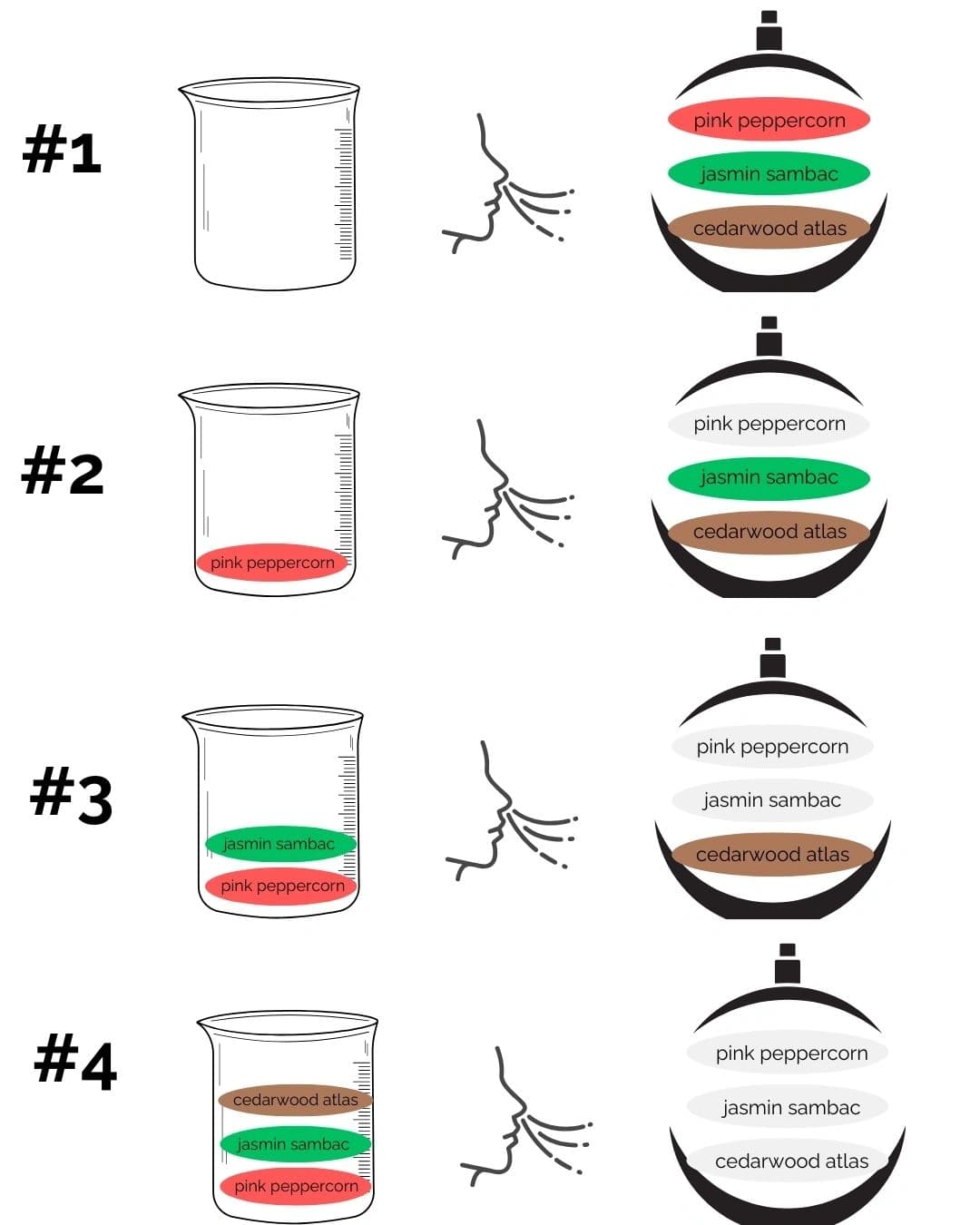
- By smelling your raw materials, You recognized a pepper from the perfume and figured out it's a pink pepper (spicy, fresh, crispy, a little bit citrusy). Add it to your sample (#2 on the picture, on the left).
- Smell your sample a few times, inducing temporary odor fatigue. Now your nose (actually brain) is blind to pink pepper. Now your target perfume smells everything except pink pepper (step #2 on the picture). Try to recognize the next note and add it to your formula.
- Repeat the same trick until you recognize and reproduce all main notes (#3 and #4).
This is how you can analyze and recreate similar perfumes. In practice, though it's unlikely that you'll be able to pick up 0.01% traces of some aroma chemical with your nose, but you can find the main structure and build around it. It does require a wide knowledge of raw materials and knowing nuances, many iterations, and balancing the formula.
Filed under
perfume making
research